Innovation Hubs — NCIC & NEHIH
Two firsts, one agenda. From the Office of the Vice President, Ife led a planned network of innovation hubs — one in each of Nigeria's six geopolitical zones, plus Lagos and Abuja. Two of them opened in a single season of 2018 and are still running today: a climate innovation centre in Lagos and a humanitarian innovation hub in Yola. When the Vice President launched the Yola hub, he named the Lagos centre in the same speech — publicly tying them together as siblings under one programme.
Nigeria Climate Innovation Center
The challenge
In 2016, 85 million Nigerians lacked access to grid electricity, yet the country had only a thin pipeline of off-grid solar enterprises and no institution dedicated to growing them. The World Bank had launched climate innovation centres in Kenya, Ghana, Ethiopia, Morocco, South Africa, Vietnam and the Caribbean — but not in Africa's largest economy.
What I did
As Special Assistant on Innovation, Ife led the government side of an 18-month design engagement with the World Bank Group: shaping the Centre's scope around off-grid solar and green enterprise, positioning it within the Office of the Vice President's Innovation Hubs agenda, and brokering the anchor partnership with the Enterprise Development Centre of Pan-Atlantic University. He secured and processed the government financing that launched the Centre — roughly $800,000 in anchor funding from the Office of the Vice President at a time when no other donor had yet committed, including the facilities funding that gave the NCIC its first home in Lagos.
What it became
The NCIC launched in 2018 and has grown into Nigeria's leading green-economy institution: 60+ climate ventures incubated, 24 seed-funded, and over $3 million in green-economy projects delivered with partners from the Coca-Cola Foundation to GIZ and UNDP. Alumni include PowerStove, which won $500,000 at the Entrepreneurship World Cup, and eTrash2Cash, a Forbes Africa 30 Under 30 honouree. The Centre now leads circular-economy programming across four West African countries.
North East Humanitarian Innovation Hub
The challenge
Years of insurgency had displaced millions across Nigeria's North-East, creating humanitarian needs that conventional aid alone could not meet. The question Ife put on the table at the Office of the Vice President was different from the standard aid response: could the region's own young people build the solutions — and could government build them a permanent home to do it in?
What I did
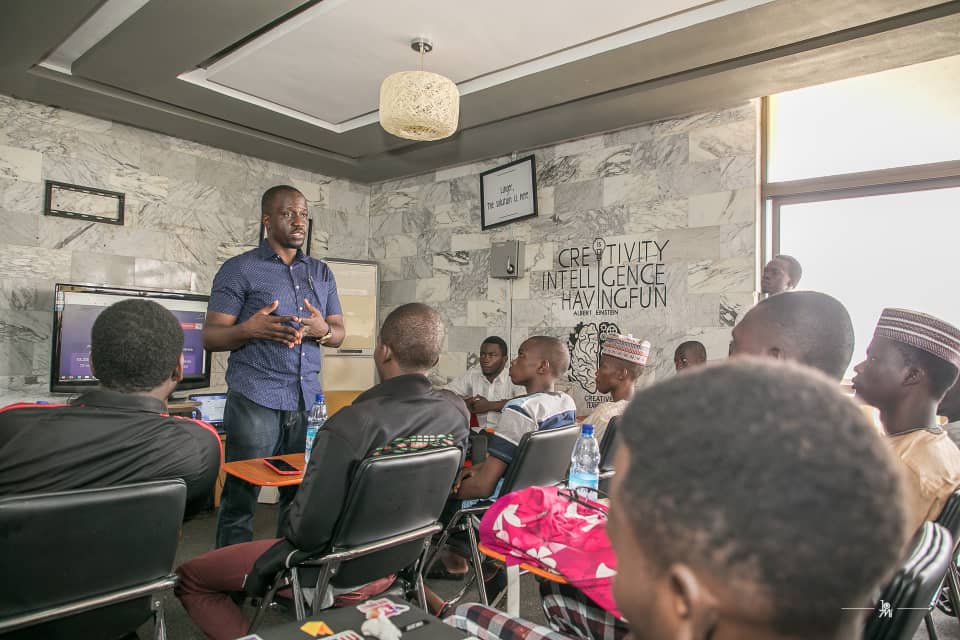
Ife designated the North-East hub for humanitarian solutions and built the coalition to deliver it. He led the government's engagement with the International Committee of the Red Cross, whose input reshaped the hub from a technology centre into a genuinely humanitarian innovation institution, and structured the three-way partnership between the Office of the Vice President, the ICRC and the American University of Nigeria, which provided the hub's home in Yola. Across three signed memos he initiated and secured over ₦82.5 million in government financing for the Northeast Makeathon and the hub's first maker-space labs — a CISCO Internet of Things programme and a GE-partnered 3D printing facility — and personally opened the door to the global e-NABLE network on 3D-printed prosthetics. The Makeathon took co-creation teams into IDP camps to define the region's priorities before a national call drew more than 1,400 applications.
What it became
The Vice President launched the hub in Yola on 5 June 2018 — Nigeria's first humanitarian innovation hub — where a nine-year-old boy displaced by the conflict was fitted with a 3D-printed limb, made on a printer line the hub had funded four months earlier. Eight years on it operates as an independent institution: its 3D printing lab has fitted prosthetics for conflict-affected beneficiaries, and its Women Codepreneur programme graduated 800 women in its first cohorts. Today it runs a 3D Printing Academy, youth innovation clubs, entrepreneurship bootcamps and vocational training with GIZ.